The Straight Line Is Free
AI now gives us the most probable answer to almost anything, for almost nothing. What becomes of us when answers arrive before judgment?

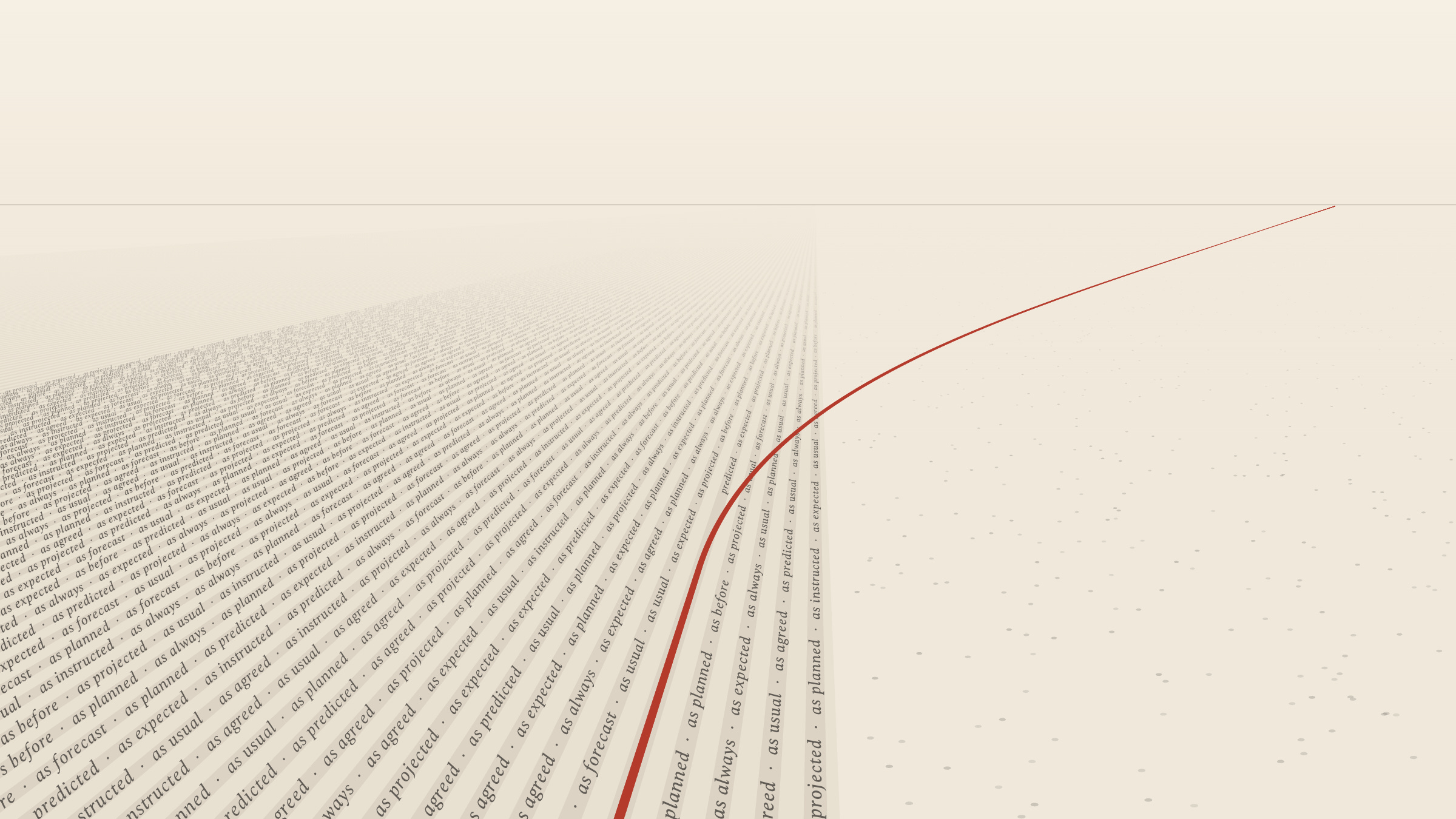
The forecast is accurate. The goal is wrong.
By the time somebody says so, there’s usually a plan, a budget and a room full of people explaining why it’s too late to turn back. Everyone has done their part well, and that’s what makes it so hard to stop. Competence can carry a company, a government, even a whole civilization a long way before anyone asks where it’s going.
Today a convincing plan arrives in seconds. Ask a chatbot for a strategy, a policy brief, a sermon or a reply to your boss, and you have something fluent, sensible and usually remarkably good (or, for those still using free AI models, good enough). Underneath, it’s always the same move: take everything that came before and predict what’s most likely to come next.
I call that move the straight line. It’s the next word, the expected recommendation, the plan that carries the present into the future without reopening its assumptions. For most of human history, drawing that line well took years of training. Now it costs almost nothing.
The straight line is free, and the consequences run far beyond the office. It’s going to change what our work is worth, what leadership means and what it takes to remain the author of our own lives. It also raises a question on the scale of civilizations: can a society that hands its next step to prediction still become something other than its own forecast?
That’s where The Erratic begins.
What the straight line used to cost
Think about what we’ve long paid professionals to do. A good doctor recognizes the usual illness behind the usual symptoms. A good translator finds the phrase a native speaker would expect, a good teacher the explanation that works for most of the class, and a good manager the sound plan and the polished email. All of them are drawing straight lines, expertly. That skill took years to learn, it was scarce, and we were right to reward it.
Machines already draw those lines in seconds: the serviceable summary, the passable translation, the standard contract, the reasonable projection and the decent first draft. Much of that is welcome, since nobody needs to spend a life composing routine correspondence to prove they’re human. But the answer has become cheap and the decision hasn’t. Someone still has to check the contract, test the projection and live with what follows.
When something scarce becomes free, its value moves to whatever is still scarce, and we’ve watched that happen before. The electronic spreadsheet replaced a great many bookkeepers and accounting clerks, yet the number of accountants grew, because their work moved from adding up columns to what one of them called “the what-if game.”1 In 2018, three economists made the same argument about AI in a book called Prediction Machines: when prediction gets cheap, human judgment becomes more valuable.2
They’re right, and I’d push their argument in two directions. First, the value moves to a particular kind of judgment: knowing when to leave the line, and being willing to answer for it.
Second, that judgment has to come from somewhere. It isn’t a reserve tank that stays full because we’ve decided machines shouldn’t touch it. It grows by making distinctions, testing them, meeting objections and living with the consequences, and for generations much of that practice happened inside the routine work machines now do. An institution can keep producing excellent work while quietly losing the practices through which its people learn to do it. A whole culture can do the same, on a larger scale and with a longer delay. The straight line becomes free at the very moment we most need people who know when to leave it.
Your consistency is your exposure
Most of us were trained, praised and promoted for drawing straight lines. At school we learned to give the answer the teacher expected. At work we gave clients exactly what they expected, used the framework that worked last time and never surprised anyone in a meeting. Institutions of every kind rewarded the people whose next move was easiest to forecast.
Some of that consistency deserves its reputation. It makes cooperation possible, and without it a promise would be worth very little. But keeping your word and repeating yourself are different achievements.
Whatever in your work can be read, copied and repeated can now be done without you, and every time you meet a new situation with your usual formula, you’re training your replacement. The quieter risk is worse: when the formula stands in for attention, you slowly lose the ability to notice when your usual answer is wrong. For decades we made ourselves as predictable as machines, and we did it on purpose, because it paid.
The same holds for whole societies. Our platforms already know what we’ll click, buy and probably say next. A public that can be forecast that precisely is easy to steer, and a culture that takes its words and ideas from the same predictor drifts toward the same few answers. Every society that renewed itself depended on people it couldn’t predict.
When a forecast becomes fate
There’s an older warning behind all of this, and it comes from my own field. Ernesto de Martino, the Italian historian of religions who was the subject of my first book, studied what happens to people when their world stops holding together. His last, unfinished book is a study of what he called cultural apocalypses, the moments when a world comes to an end for the people who live in it. I spent months reading his papers in Rome.
Arguing with Claude Lévi-Strauss, de Martino worried about a science that observes human beings from the outside, “as if they were ants.” Followed to its end, he argued, such a science forecasts a humanity turned into an anthill and hands us “a cold scientific prediction, which already dictates that we should adapt to the event just as it is necessary to adjust oneself in the autumn for the following and inevitable winter.”3 He was writing about anthropology more than half a century before ChatGPT, and his question has only grown since: when does an account of what may happen become an instruction to stop making history?
That’s the straight line at its most dangerous: the forecast treated as fate. We can respect a forecast and still refuse that surrender, by asking what it assumes, whose purposes it serves and what our response could change. The stakes are civilizational. A person who takes the forecast for fate stops choosing, and a civilization that does the same stops making history and settles for adapting to it, like de Martino’s ants bracing for winter.
The departure that knows why it departs
So what keeps its value when the straight line is free? Randomness won’t do it: a machine can be made random at the turn of a dial, and noise has never been worth much. Contrarianism won’t either, because the pleasure of dissent is just another predictable habit. What stays scarce is the departure that knows why it departs: someone notices that a familiar pattern has stopped working, investigates why, and has the discipline to leave it and the courage to answer for what follows.
I call this erratic intelligence: the disciplined departure from a pattern that no longer fits reality.
The name is deliberate. We usually hear “erratic” as an insult: an erratic employee, an erratic market, an erratic heartbeat. The Latin behind the word is less judgmental. Errare meant both to wander and to be mistaken, and when Cicero changed his mind in public about a political decision, he told the Senate that anyone can err and only a fool persists in error.4 Exploration and fallibility have shared a word for two thousand years, because nobody finds anything new without leaving the path, and nobody leaves the path without the risk of being wrong. Geologists borrowed the word for boulders the ice carried far from home, and I tell that story on the About page.
My favorite example of erratic intelligence comes from the sky. The ancients called the planets wandering stars, and in the early 1600s one of them, Mars, refused to fit. Johannes Kepler’s best model of its orbit disagreed with Tycho Brahe’s observations by eight minutes of arc, about a quarter of the width of the full moon. Kepler could have blamed the observations or patched the model, as astronomers had done for centuries to save the circle. He trusted the data instead, wrote that “these eight minutes alone will lead us along a path to the reform of the whole of Astronomy,” and went on to find the ellipse.5 Newton would later build his physics on Kepler’s laws, so eight minutes that one astronomer refused to explain away helped change how a whole civilization understood the sky.
Where leadership lives now
AI can help with this work. Today’s software would catch Kepler’s eight minutes in a moment, and it can offer alternatives and expose the weak points in our reasoning. What it can’t do is answer for the call. Judgment means understanding a recommendation well enough to accept it, change it or refuse it, and then standing behind the result, which takes more than a signature.
Departing doesn’t make us right, either. Sometimes the disciplined move is to drop an exciting objection because the evidence supports the ordinary answer. Erratic intelligence needs a way back as well as a way out, and Cicero gave the Senate the formula in that same speech: if we have erred, let us return to the road.
Leadership now lives in the gap between what the system recommends and what the situation actually requires, and the value of standing in that gap rises as fast as the cost of the straight line falls. That gap opens wherever someone has to answer for a decision: in a classroom, a clinic, a courtroom, a family or a parliament. Organizations and societies that iron the erratic streak out of their people end up fragile, with interchangeable leaders. If we expect people to answer for their decisions, we have to give them room to understand and question them.
That’s the argument of my new book, Erratic Intelligence: Leadership in the Age of AI, which came out on October 27, and it fits in two sentences: AI is built to predict. Leadership begins where prediction ends.
The product without the passage
This reaches well beyond work. AI can help someone find words for a condolence message when they have none, or write with care in a language they’re still learning, and there the tool makes an encounter possible. It can also let us finish the message without pausing over the person who will receive it. A polished expression of concern can come from an act of attention or from an attempt to avoid one, and the quality of the sentence can’t tell us which.
That’s what I mean by the product without the passage: we receive what a human process usually produces while skipping what the process asks of us. Sometimes the help removes an obstacle to learning, and sometimes it removes the occasion to learn.
Historians of religions have a name for passages like these. Cultures across the world have built rites of passage around birth, coming of age, marriage and death, because the passage is what forms the person, and a culture lasts only as long as it keeps forming people who can carry it. A civilization that takes the products and skips the passages can keep its outputs for a long time while it quietly loses the people who could renew it.
The question I want to follow is simple enough to take almost anywhere: what is this making of us, one life at a time and as a civilization? That question has a name, Technopsychology, and the next issue is devoted to it.
What The Erratic is for
My own life has rarely run in a straight line. I’ve lived in nine countries on four continents, spent a stretch living in a van and another in long solitary retreat, and come close to dying. I became a historian of religions, teaching Tibetan Buddhism in Sydney while advising leaders on what AI is doing to their decisions.
On paper that looks erratic. From the inside it has been one long investigation of how human beings are formed, by their traditions and now by their tools. I’ve followed that question through Tibetan contemplatives, through de Martino’s studies of people whose world was ending, through leaders in the room where a decision has to be signed, and through the more than fifteen languages I’ve worked in. AI has given the question new urgency without shrinking it to a question about machines.
What remains ours when intelligence is everywhere? Not output, and not information. The human advantage begins deeper: in attention, judgment, experience, responsibility and the courage to depart from the pattern.
The Erratic is where I’ll test that answer in public. Every other Sunday I’ll publish an essay. Some will follow judgment into boardrooms, classrooms, clinics and monasteries, or work through the economics of prediction. Others will trace a word across languages, go into what the oldest contemplative traditions knew about attention and crisis, or ask how taste becomes wisdom. There’ll be room for fiction, too. Each one will give you at least one thing you couldn’t have predicted from its title. That’s the whole editorial policy, and it’s why the masthead says Consistently unexpected.
For this first issue, take one decision you made this week, at work or anywhere else. Did you make it, or did you sign off on the straight line? What did you notice, question or change before you put your name to it? Hit reply and tell me. I read every reply.
The word: delirare
Every issue of The Erratic ends with one word and its history. The first takes us into a field.
In Latin, lira was the ridge of earth a plow throws up between two furrows, and by extension the furrow itself. The Roman grammarian Velius Longus explained delirare, to be out of one’s mind, with the image behind it: oxen that turn aside from the straight course of their work are said to delirare, and so, by the same figure, are people who leave the straight path of life for a crooked one.6 English delirium comes from the same verb. Ever since the Romans, our languages have filed the departure from the straight line under madness, and sometimes that’s exactly what it is.
But the story runs deeper. Historical linguists trace lira to an Indo-European root meaning a track or a furrow, and they trace English learn and lore, and German lernen, to the same root.7 At its origin, to learn was to follow a track. So one furrow gave us both words: learn, for keeping to the line, and delirium, for leaving it. Erratic intelligence needs both.
A furrow is something somebody made, and its straightness doesn’t settle what the field is for.
Stay erratic,
Flavio
P.S. You can read the whole Introduction of Erratic Intelligence free here.
Jacob Goldstein, “How the Electronic Spreadsheet Revolutionized Business,” NPR, 2015.
Ajay Agrawal, Joshua Gans and Avi Goldfarb, Prediction Machines: The Simple Economics of Artificial Intelligence (Harvard Business Review Press, 2018). They explain AI through the falling cost of prediction; the turn to how judgment is formed is mine.
Ernesto de Martino, La fine del mondo: Contributo all’analisi delle apocalissi culturali (Turin: Einaudi, 1977), pp. 689–90, quoted in my translation in The Life and Work of Ernesto De Martino: Italian Perspectives on Apocalypse and Rebirth in the Modern Study of Religion (Brill, 2021), p. 81, open access. De Martino is answering Lévi-Strauss; the application to AI is mine.
Cicero, Philippics 12.5 and 12.7: cuiusvis hominis est errare, nullius nisi insipientis in errore perseverare and quodsi est erratum … redeamus in viam. He is retracting his earlier support for sending envoys to Mark Antony. Latin text.
Johannes Kepler, Astronomia nova (1609), ch. 19, trans. J. V. Field, quoted in MacTutor History of Mathematics.
Velius Longus, De orthographia, in Heinrich Keil, Grammatici Latini VII, 73 (PHI Latin Texts); Charlton T. Lewis and Charles Short, A Latin Dictionary (1879), s.v. lira.
Discussion about this post